Updated 24 November 2026
Are system design interviews random? What varies and what you control
Some of it is luck. What the data says, how to tell which round you are in, how deep to go on numbers and named tools, and how to handle any interviewer.
Partly. Two interviewers can judge the same person differently, and there is data that shows it. But most of what feels random in a system design round is variation you can find out before the day or spot in the first ten minutes: which kind of round the company runs, how deep this interviewer wants to go, and which part of the design they care about. What is left is luck, and the answer to luck is to raise your pass rate and sit enough loops that one bad draw does not decide anything.
This guide takes it in that order: how big the randomness is, the kinds of round and how to tell them apart, how deep to go on numbers, row sizes and product names, how to handle whoever you get, and how many rejections it takes before the problem is probably not luck.
How random is it? What the data says
Two sources put a number on it. Neither is about design rounds in particular, so read them as the size of the problem, not as your odds.
- The same person, several interviews. interviewing.io, a platform for technical interviews, looked at people who had done at least two on it. Across more than a thousand interviews, "roughly 20% of interviewees are consistent in their performance" (interviewing.io, the later analysis). An earlier look at 299 interviews found that people who are "overall pretty strong" on average "can mess up technical interviews as much as 22% of the time" (the first analysis). The questions there tended to be the kind you meet in a phone screen. The author also warns against comparing raw scores, because "one interviewer's 4 is another interviewer's 2".
- Different interviewers, the same candidate. A study that pooled earlier research on job interviews of every kind (125 coefficients, a total sample of 32,428) put the agreement between interviewers at .74 when they sat on one panel and .44 when each held a separate interview, where 1 would be perfect agreement (Huffcutt, Culbertson and Weyhrauch, 2013, from its abstract). Not all of that gap is the interviewers. In separate interviews you are a slightly different candidate each time as well.
Agreement of .44 does not mean a 56% chance of the wrong result. It means one interview is a noisy measurement, which is one reason companies use several. If you average interviewers who are all judging the same thing, a standard formula for averaging ratings (Spearman-Brown: k × .44, divided by 1 + (k - 1) × .44) gives .61 for two interviewers, .70 for three, .76 for four and .80 for five. The gain is large at first and small after four. Google reached a similar place. As Laszlo Bock tells it in his book Work Rules!, one of its staffing analysts found that four interviews were enough to predict, with 86% confidence, whether the company should hire someone, and the company made it a rule (Knowledge at Wharton, 2016).
- One interviewer.44
- Two.61
- Three.70
- Four.76
- Five.80
- Perfect agreement1
That suggests why the design round is the one that feels like a lottery. A loop may have four or five interviews, but usually only one or two of them are design. The rest of the loop can still outweigh a bad design round, but there are not four design interviewers to average over. And design leaves more to the person across the table than code does. A program can be run against tests. A design cannot, so what the interviewer knows and cares about finds its way into the grade. That last step is our reasoning, not a measurement.
Some companies build against this, and say so:
- Set questions and a written scale. Google says it uses the same interview questions and grades answers "on an identical scale" (Google re:Work). Atlassian says its systems design interviewer "will choose from a set of structured questions" (Atlassian, engineering interviews).
- A decision made by someone else. Atlassian adds that its "Hiring Committee works independently from our interviewers".
- An outsider in the loop. Amazon's Bar Raisers are employees who act as "objective third-party advisers" and help make the final decision (Amazon, on Bar Raisers).
Structure does not remove the noise: the abstract of the 2013 study describes the agreement for highly structured interviews, held separately by different interviewers, as lower than expected. But in a loop like that, one interviewer's opinion reaches the decision as one set of notes among several. Your job in the room is to make those notes good whoever is writing them.
Where the differences come from
| What differs | When you can know | What to do about it |
|---|---|---|
| The kind of round | Before the day | Ask the recruiter, and practise that kind |
| The length and the drawing tool | Before the day | Practise at that length, in that tool |
| The level you are graded at | Before the day | Ask, and practise to that bar |
| The prompt | Partly, from what the company is reported to ask | Learn the method, not the answers |
| How deep, and on which part | In the first ten minutes | Offer a choice, and watch which part they take |
| The interviewer's manner | In the first ten minutes | The moves further down this page |
| You, on the day | On the day | Practice out loud, sleep, a tool you know |
| Who else applied, and how many openings | Never | Nothing, so do not spend worry on it |
Only the last row is out of your hands completely. The other seven shrink with preparation. Often what people call random is the fifth: they prepared one depth, and met an interviewer who wanted another.
Which kind of round is this?
Companies test design in more than one kind of round, and do not always call it system design. These descriptions come from their own pages, read in November 2026:
- An open design. Atlassian's round is a 60-minute session where the goal is not code, there is "no one right answer", and the follow-ups get harder or easier as you go. At Monzo the problem is "a hypothetical, non-Monzo related problem", drawn in a tool like Excalidraw, with "no points for neatness of diagrams" (Monzo, backend interviews).
- An open design that can drop to data structures. In an interview of about an hour, Wise presents "a product task or problematic area", asks for a high-level architecture, and says it may "delve into lower-level aspects such as defining data structures" (Wise, backend system design).
- A design question inside another interview. Amazon's SDE II loop is four 55-minute interviews, and candidates are told to expect "at least one question on software systems design" (Amazon, SDE II prep). Our guide to the Amazon SDE-2 loop takes it round by round.
- A system you built. This one may go by another name, but it tests the same judgement. Ashby's final round includes a 30 or 45 minute walkthrough of a past project: "We might go very deep into pieces we find interesting" (Ashby, past projects deep dive). Monzo's process for senior staff engineers and above has both: after the recruiter call, a one-hour call that goes into how a project came together and what its trade-offs were, and later a systems design interview (Monzo, senior staff interviews).
- A design with an AI assistant in the tool. Meta says "Select roles now include an authorized AI assistant within CoderPad during technical interviews", and that "Design interviews will be conducted in CoderPad with Mermaid Markdown" with the same assistant (Meta, hiring process). Ask your recruiter whether yours is one of them.
Two more rounds often get called system design as well. Product architecture is closer to APIs and data models than to infrastructure (how Meta splits the two), and low-level design means classes and interfaces, often as code. If you prepare for one kind and meet another, the round will feel arbitrary, although nothing about it was. For the usual one minute by minute, see what happens in a system design interview.
You can usually tell which one you are in from the first sentence:
| What you hear | Probably | Your first move |
|---|---|---|
| "Design a service where people can..." | Open design | Scope it, then name the hard part |
| "Design the API (or the data model) for..." | Product architecture | The entities, the calls, one whole flow |
| "Design a rate limiter, a queue, a key-value store" | Infrastructure | What it promises when a machine dies |
| "Tell me about a system you built" | Past project | The goal, your part, the hardest decision |
| "How does this technology work?" | A drill-down on one tool | Answer it, then say when you would not use it |
| "Write the classes for..." | Low-level design | Ask whether the code should run |
If you still cannot tell after two minutes, ask: "Would you like me to spend the time on the product flow, on the infrastructure under it, or on the code structure?" And if the round changes shape halfway, say so out loud: "I will leave the overall design here and go into the consumers. Tell me when you want the rest."
How deep to go
Go one level below the decision you are making, offer the next level, and let the interviewer choose. Much of the trouble with depth comes from skipping the offer. "Too shallow" usually means a part the interviewer was waiting for you to open. "Too deep" usually means ten minutes on a part they never asked about. One sentence prevents both: "The three hard parts here are the fan-out, the duplicates and the hot users. I would start with the duplicates unless you would rather see another."
Numbers and row sizes
A number earns its place when a different value would give you a different design. Take a chat system that stores 100 million messages a day.
- At 300 bytes each, that is 30 GB a day, about 11 TB a year. At 360 bytes it is about 13 TB a year. The decision is the same either way: partition the messages and move the old ones to cheaper storage. The exact row size does not matter, so say "a few hundred bytes a row", do one multiplication, and move on.
- Now ask whether the sessions of 10 million connected users fit in memory. At 1 KB each, that is 10 GB, and one cache machine holds it. At 20 KB each, it is 200 GB, and you need several machines and a way to split the sessions between them. Here the size decides, so it is worth thirty seconds to list what a session holds.
If the interviewer asks for the row size anyway, build it out loud: an 8-byte id, two 8-byte user ids, an 8-byte timestamp and about 200 bytes of text make 232 bytes, so call it 300 with overhead. Nobody needs the second digit. Back-of-the-envelope estimation has the method, and latency numbers the few worth remembering.
Named products
Say what you need, then name the product, and go further only where the round turns. Four depths, with a queue as the example:
- The property. "I need a durable log, split by user, so each user's events stay in order."
- The product, and the reason. "Kafka fits, because events with the same key go to the same partition, and a consumer reads a partition in the order it was written."
- The mechanism, and its limit. "Within a consumer group, a partition is read by one consumer at a time. So with ten partitions, at most ten consumers in that group do any work."
- The failure, and the fix. "One very active user is one key, so one partition, so one consumer. Adding consumers does not help. I would split that user over several sub-keys and accept order only within each one."
The facts in 2 and 3 are in Kafka's own introduction and design pages. The first depth is owed for everything you draw. The second is owed for every product you name. The third and fourth are for the two or three parts the problem hinges on.
- PropertyWhat you need from it, with no product name
- ProductThe one that fits, and the one reason it does
- MechanismHow it does that, and the limit that follows
- FailureWhat breaks first, and what you would change
The test for naming a product is whether you can go one question past its name. Monzo's backend guide recommends sticking "with technologies which you are familiar with and can reason about". Its senior staff guide warns about buzzword technologies and adds: "We will probe deeper on why you believe such a component makes sense." interviewing.io's guide puts it more bluntly: "Say the generic name of the component, not the brand name unless you are very familiar with it" (interviewing.io, system design guide). Stopping at the property is a complete answer for a technology you have not used.
How deep at each level
This is our reading, in line with what interviewers expect at each level:
- Mid-level: the property for everything you draw, the reason for every product you name, and the mechanism when you are led to it.
- Senior: the mechanism and the failure for two or three parts, which you choose and say you are choosing.
- Staff: all four depths on the hardest parts, plus what they cost to run and how they change over the next few years, and a quick pass over everything routine.
One design, three rooms
Here is how one answer can meet three different rounds. The prompt is to design a notification system, and the same board goes up in each room: services call a notify API, the API checks the user's preferences and puts a message on a queue for that channel, workers send it through the push, SMS and email providers, and the workers write each send to a log.
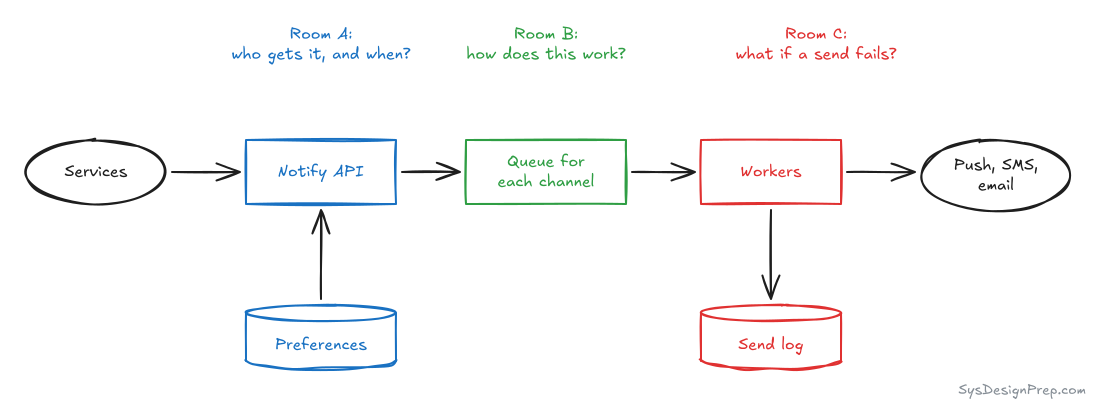
| Room | Where the middle of the round goes | What a good answer has |
|---|---|---|
| A: the product | Quiet hours, opting out, turning fifty likes into one message | Who is told what, and where that rule runs |
| B: the internals | The queue: its key, its order, what happens when it backs up | The four depths above, down to the failure |
| C: the failures | A provider is down for twenty minutes, then a worker dies halfway through a send | Retries with a limit, what the user sees, duplicates |
Room C's last question has a precise answer. If a worker dies after the provider has accepted the message and before the log is written, the queue hands the message to another worker, which sends it a second time, unless the provider accepts an idempotency key. So use the key where there is one, and say plainly that a rare duplicate is the price where there is not.
Someone who prepared only the queue walks out of room A saying the interview was random. Someone who prepared the board and one good dive in each direction has an answer in all three. That gives a practice rule that beats studying more questions: for every question you practise, prepare three dives, one on the product, one on the internals of one component, and one on a failure.
How to handle the interviewer you get
You cannot choose the interviewer, but each manner has a move. The words are examples, so use your own.
- Says almost nothing. Quiet is style, not a verdict. Narrate, and at each change of stage offer two directions: "I can go into storage or into delivery next. Which is more useful?" A choice of two is easier to answer than "is this OK?"
- Looks distracted, or keeps typing. They may be taking notes. Either way, let the board carry the interview: write down the requirements, the numbers and the decisions as text, so someone who missed a minute can read it, and recap in one sentence at each change of stage.
- Will not answer your questions ("what do you think?"). Propose and write it down: "I will assume 10 million daily users and delivery within a minute. Stop me if that is off." Then design to it. It is a hand-over of the scoping, not a refusal.
- Keeps steering to one technology. Ask which requirement it serves: "Is there something I have missed that rules out what I have?" If there is, you have learned it, so change the design. If there is not, weigh it out loud: "That would work. It would give us ordering, and cost us a second system to run. At these numbers I would stay with the table, and move if the writes grow ten times." That shows more judgement than digging in or giving in.
- Stays inside one box. Follow, but protect the whole: "Happy to go further into this. Let me first put the rest of the flow on the board in two minutes, so we have the full picture." Then go deep. They may have a whole rubric line on that box.
- Pushes back on everything. Take each one as a question: restate it, weigh it against the requirements, then keep the choice or change it, with the reason. When the interviewer pushes back has replies that work.
- Cuts you off and moves on. They may have what they needed, or a fixed list of questions to get through, which is what a structured interview is. Finish the sentence, not the paragraph, and go where they point.
- Has a different answer in mind and says yours is wrong. Go back to the requirements, because they are the one thing you both agreed to: "We said a post may appear a few seconds late. Does this break that?" If it does, thank them and fix it. If it does not, the disagreement is now written in terms of the requirement, which is how you want it to appear in the notes.
Asking questions is part of the round, and it can be overdone. Keep the opening to questions whose answers would change the design, and turn the rest into stated assumptions. Functional and non-functional requirements lists the ones worth asking.
Make yourself hard to misread
A write-up is made from notes, so say the things that matter in a form that can be copied down.
- Minute 1: the plan. "I will take five minutes on requirements, fifteen on numbers and a design that works end to end, and the rest on the hard parts. Is there anything you particularly want to get to?" You have just asked how deep, and where.
- Minutes 2 to 5: assumptions as a list. Write each one on the board with a number: A1, A2, A3. A disagreement now shows up as "change A2", not as "wrong design".
- Minute 5: the hard part, named. "The hard part is sending once when a worker can die halfway. Does that match what you had in mind?"
- At each change of stage: one sentence. "So far: one flow, end to end, for 2,000 messages a second. Next, the failures."
- The last two minutes: the summary. What the design does, what you gave up, what you would do next, and what you are least sure of.
- Minute 1Say the plan, and ask what they want to get to
- Minutes 2 to 5Number the assumptions on the board
- Minute 5Name the hard part, and check that they agree
- Each stageOne sentence on where the design stands
- Last twoWhat it does, what you gave up, what is next
What to say in a system design interview has more phrases for each stage.
Ask the recruiter before the day
Recruiters can often answer these, and most of the answers take a row out of the table near the top of this page. Send them in one email.
- How many design rounds are there, and how long is each?
- Is it an open design, APIs and data models, a past project, or class design?
- Which tool will I draw in, and may I practise in it?
- Is an AI assistant part of any round, allowed, or not allowed?
- Which level am I being considered for, and can the loop change it?
- Will the interviewers be from the team I would join, or from anywhere in the company?
- Is there a preparation page or a guide you share with candidates?
The company pages on this site list the questions each company is reported to ask, and for many of them the mock page also says what the round is reported to look like and what it weighs, for example Amazon and Stripe.
Was it luck, or a pattern?
Suppose you would pass 60% of design rounds at the level you are aiming for. You would still fail one 40% of the time.
| If you would pass | Fail one | Two in a row | Three in a row |
|---|---|---|---|
| 40% of rounds | 60% | 36% | 22% |
| 60% | 40% | 16% | 6% |
| 75% | 25% | 6% | 2% |
- One failed round tells you almost nothing. Someone who passes 75% of them still fails one in four.
- Two in a row is a reason to get an outside read.
- Three in a row happens to someone with a 60% pass rate about one time in sixteen. Either you were unlucky, or your pass rate is not 60%. Plan as if it is the second.
The same arithmetic says why to sit several loops. At 60%, the chance of passing at least one design round in three tries is 94%. At 40%, it is 78%. If the loop has two design rounds and you need both, 60% each becomes 36%, and at least one success in three loops becomes 74%. Practice moves the pass rate, and more loops move the rest. All of this treats rounds as independent, which flatters you: a gap that failed you in one room walks into the next. Read the odds as the best case.
Better evidence than the count is where each round went wrong, so write it down the same day. A tool failure, a late interviewer, a prompt from a field the job does not touch, a requirement they went back on, or a different weak stage each time all point to the draw. Running out of time before the deep dives more than once, stalling twice on the same kind of follow-up, having no reason for a choice, or a board nobody else could read all point to a pattern. After one bad draw, change nothing and sit another round. After the same stage twice, fix that stage before you sit another.
The draw, or a pattern?
Probably the draw
- The call or the drawing tool failed, or the interviewer came late
- The prompt needed knowledge of a field the job does not touch
- They went back on a requirement you had both agreed
- Each round went wrong at a different stage
Probably a pattern
- You ran out of time before a deep dive, more than once
- The same kind of follow-up has stalled you twice
- You could not say why you chose something over its obvious alternative
- Someone reading only your board could not say what the system does
One bad draw: change nothing, and sit another round. The same stage twice: fix that stage before you sit another.
The signs during the round itself are in how to tell if your system design interview went well, and the self-check grades your answer stage by stage.
If the interviewer really was the problem
It happens. Someone does not turn up, spends the round on their phone, or is rude. Do three things, soon:
- Write down the facts the same day: times, what was said, how many minutes were lost. Facts, not conclusions.
- Tell the recruiter before the decision if you can. Afterwards it reads as an appeal. Something like: "I wanted to mention that the design round started 15 minutes late and the whiteboard did not load for me until minute 25, so we did not reach the deep dives. I enjoyed the conversation, and I would be glad to repeat the round if that is possible."
- Ask for a repeat, not for a verdict. A lost quarter of an hour is easy for a company to fix. "The interviewer was biased against my answer" is not, and it is rarely a thing you can show.
Questions about your age, family, health or religion are a different matter. That is not luck, and it belongs with the recruiter in writing.
Practise for a round you cannot predict
Most practice repeats one kind of round with one kind of interviewer, which is how people end up strong in one room. Vary the room on purpose.
- Prepare three dives for every question: the product, the internals, a failure.
- Once a week, take a question you have never seen. It is the best test of whether the method carries over.
- Take one question through three interviewers. If you use a chat assistant, start from the interviewer prompt and paste this under it:
Before you start, pick one of these three manners at random. Do not tell me which, and keep to it until I write END.

1. Say as little as you can. Answer my questions with "what do you think?", and ask at most one follow-up in each stage.
2. From my [20 min] mark to my [40 min] mark, stay on one component of my board, going one level deeper each time.
3. You believe a different technology is right for my main store. Push me towards it twice, and give your reason only if I ask for it.

Where the manner clashes with the rules above, follow the manner. In the debrief, say which manner you used and how well I handled it.- Keep the judge fixed while you vary the rest. If you want to know whether you are improving, the measure has to stay still. In the AI mock, where you test yourself in a round timed like the real one, the rubric stays the same, the level is the one you pick, the interviewer asks one thing at a time and reads your board, and each round ends with a score out of 100, a hire or no-hire call for your level and a note on every stage. One score is still one sample: look at which stage keeps coming up. How the mock is scored is public.
- Then sit at least one round with a person. A stranger's manner is the thing no fixed judge can give you. How to practise on your own compares the options.
You will still draw a bad interviewer now and then. It should cost you one round, and not your confidence in the method.
Questions people ask
Are system design interviews random?
Partly. Interviews are noisy measurements: one study that pooled research on job interviews put the agreement between interviewers who each held a separate interview at .44, where 1 is perfect. But much of what feels random in a design round can be known before the day (the kind of round, the length, the tool, the level) or spotted in the first ten minutes (how deep the interviewer wants to go, and on which part). Prepare for those, and sit several loops so that one bad draw does not decide the outcome.
Why are system design interviews so inconsistent from company to company?
Because companies test design in different kinds of round. Some run an open design of a hypothetical system, some put a design question inside another interview, some discuss a project you built, some drop down to data structures, and some give you an AI assistant in the tool. Ask the recruiter which kind it is, how long it runs and what you draw in, and listen to the first sentence of the prompt, which usually tells you.
How deep should you go in a system design interview?
One level below the decision you are making, then offer the next level and let the interviewer choose. Every box you draw needs the property it provides, every product you name needs a reason, and the two or three parts the problem hinges on need the mechanism, its limit and how it fails. Mid-level candidates can be led to those parts. Senior and staff candidates are expected to pick them.
Do you need exact numbers and row sizes in a system design interview?
No. A number matters when a different value would change the design. Whether a message row is 300 or 360 bytes rarely changes anything, so say "a few hundred bytes" and multiply once. Whether a session is 1 KB or 20 KB can decide between one cache machine and several, so that one is worth thirty seconds. If you are asked for a row size, add up the fields out loud and round.
Should you name specific technologies like Kafka or Redis in a system design interview?
Name a product when you can go at least one question past its name: why it fits, how it does that and what limit follows. Otherwise describe the property you need, such as a durable log split by user so each user's events stay in order. That is a complete answer, and it is stronger than a product name you cannot defend.
What do you do if the interviewer has a different solution in mind?
Ask which requirement your design fails. If there is one, change the design and say why. If there is not, weigh their option against yours out loud, with what each costs at the numbers you agreed, and make a decision. Tie the disagreement to a requirement rather than to taste, so that the notes record your reasoning and not a clash of opinions.
How many failed system design interviews mean the problem is me?
One failed round says very little, since someone who passes 60% of design rounds still fails one 40% of the time. At that rate two in a row happen 16% of the time, which is a reason to get an outside read, and three in a row about 6% of the time, so treat that as a pattern rather than bad luck. Where the rounds went wrong is better evidence than the count: if the same stage failed twice, fix that stage first.